
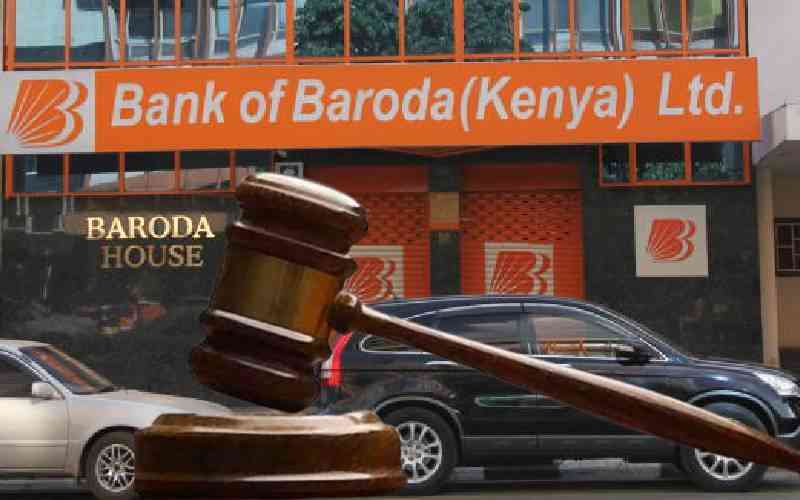
Conduct of Bank of Baroda
Bank of Baroda tried to have that judgment set aside. On 31 July 2026, Justice Mulwa dismissed the application, ruling that the bank had been given time to file its defence and simply failed to do so before the pre-trial conference, conduct he described in blunt terms as indolence. Ten days after that ruling, with the Sh2.9 billion claim now enforceable against it, the bank issued the insolvency notice that
put Rao and Swaroop Rao inside Infinity’s gates. Shah argues the timing was no accident: the takeover, he told the court, was designed to subvert the implementation of the court’s own orders, nlacing the bank’s own appointees in control of the very litigation Infinity was about to use against it.
Infinity is not a shell company invented for a court filing. Launched in 2016 by then- President Uhuru Kenyatta, the SME park was conceived as Kenya’s first private industrial estate for small manufacturers,
eventually meant to house up to a thousand SMEs on its 200 acres. Phase one, with its warehouses and infrastructure, is complete; phase two has been stuck in this same dispute over charged land for more than a year, with Shah having already lost a bid in August 2025 to force the bank to release fifteen acres to unblock it. Shah personally guaranteed the facility. If the administrators remain in place, he told the court, they control the assets and litigation posture he needs to enforce his own Judgment against the very bank that appointed them, an arrangement that would let Bank of Baroda mark its own homework.
THE ADMINISTRATORS BARODA KEEPS CALLING BACK
Bank of Baroda did not reach for unfamiliar names. Rao and Swaroop Rao are the same pairing the bank sent in against Thika Nursing Homes and Thika School of Medical and Health Sciences in November 2021, over a loan Business Daily reported at Sh262.8 million. The playbook then reads almost identically to Infinity’s now: temporary orders barring the administrators were discharged in late December, a notice ran in the papers declaring all matters now referred to the joint administrator, and the takeover proceeded regardless of the pending dispute. Counsel for the institutions, Professor Tom Ojienda, told the court the bank had listed the college with the credit reference bureau specifically to frustrate any attempt to refinance elsewhere, arguing that the manoeuvre was designed so the bank could ultimately take over the business through proxies. The Court of Appeal later declined to intervene, on the basis that the takeover had already taken effect by the time the appeal was filed
Rao’s name carries a longer, heavier file
than any single bank engagement could explain. Kenyan media have for years called him the controversial face of the country’s liquidation industry, a receiver or administrator on more contested
company files than perhaps any other individual in the market. He was appointed receiver-manager of Mumias Sugar Company in September 2019 after KCB Bank placed the miller, whose debts to creditors exceed Sh30 billion, under receivership. A parliamentary committee investigating a collapsed Sh5 billion leasing bid by Devki faulted him for never publicly advertising the process. Cane farmers have accused him of producing and selling roughly Sh880 million worth of ethanol while leaving an estimated Sh3.5 billion in taxes unremitted. Activist Okiya Omtatah went to court seeking his removal as conflicted and incompetent.
A creditor’s lawyer told the court in 2022 that Rao ought to be cross-examined over what he described as a pattern of inconsistency and concealment in his handling of the miller’s assets. In April 2022, Justice Alfred Mabeya revoked Rao’s appointment outright, ordering him to hand Mumias over to a new administrator within seven days for failing to comply with the terms of his own job. His attempt to reverse that order later collapsed when a different judge ruled she had no jurisdiction to hear it.
None of that history has kept Rao off Kenya’s insolvency circuit. He has also been receiver-manager of Athi River Steel Plant, under receivership since 2018 over a Sh7 billion debt owed to a syndicate of banks, where he has personally been served warrants of attachment, a step he argues in court papers punishes him for simply acting in a professional capacity. He and Swaroop Rao were more recently appointed administrators of bus and truck body manufacturer Labh Singh Harnam Singh over a Sh1 billion KCB debt, and receivers of cereals manufacturer Proctor & Allan East Africa in February 2025. Using the same duo for Infinity is not, on its own, unlawful. It does mean that a bank now facing a live contempt application chose,
once again, administrators whose conduct courts, farmers, activists and a parliamentary committee have separately been forced to scrutinise.
A RECOGNISABLE HOUSE STYLE
Zoom out from Infinity and Thika, and a pattern in Bank of Baroda’s enforcement conduct becomes difficult to ignore. In February 2026, the High Court in Eldoret lifted an earlier injunction and allowed the bank to auction a Sh173 million property tied to Mediheal Doctors Plaza, part of
former Kesses MP Swarup Mishra’s hospital chain, ruling that the facility had been properly served with statutory notice even though it disputed ever receiving it, a dispute the court resolved on the strength of the bank’s proof of postage alone. In a separate suit, Ndovu Estates Limited persuaded the High Court that Bank of Baroda’s own thirty-day statutory notice, the legal precondition for appointing a
receiver over its Eldoret land parcels, was defective in both form and substance, and won an injunction blocking the appointment entirely. And in ongoing litigation, Keppel Investments Limited has accused the bank of delaying loan disbursements and consents on facilities it says were never properly advanced, then levying penalties on the shortfall anyway.
Courts have not found merit in every borrower’s complaint against the bank. They have, with striking regularity, been asked to referee how Bank of Baroda wields its security rights once a customer falls behind.
What distinguishes Infinity from every one of those files is the sequencing. In Thika, Mediheal and Ndovu, the bank moved to enforce security before, or entirely without, a final judgment against it. In Infinity’s case, the bank had already lost, had already had its bid to escape that loss thrown out for what a judge called indolence, and appointed administrators anyway, over land a court order named specifically and expressly forbade the
bank from touching. Contempt of a commercial court order is not a criminal charge in Kenya, but it is treated gravely: judges have sent bank directors and company officers to civil jail for treating
court orders as optional, and Infinity’s
application asks Justice Mulwa for exactly that outcome, alongside fines and cancellation of the insolvency notice.
A PARENT BANK WITH ITS OWN RECORD OF COMPLIANCE FAILURE
Bank of Baroda (Kenya) is a subsidiary of India’s third-largest public sector lender, majority-owned by the Government of India, which has operated in the Kenyan market since 1953. Its parent brings its own history worth setting alongside its Kenyan subsidiary’s conduct. In July 2026, Bank of Baroda agreed to pay out roughly six hundred million dollars to settle claims brought by the joint administrators of NMC Health, the Gulf hospital group whose 2020 collapse exposed roughly 6.6 billion dollars in concealed debt, more than three times what the company had disclosed to its own shareholders. The administrators had accused Bank of Baroda of failing to meet basic know-your- customer and anti-money-laundering obligations on accets connected to NMC’s founder, allegations the bank denied for years before agreeing to settle. It would not have been the first time Indian regulators fined the bank over exactly that kind of lapse. The Reserve Bank of India penalised Bank of Baroda in 2016 over a fraudulent import-remittance scheme worth thousands of crores of rupees running through a single Delhi branch, and separately fined it in 2014 and 2019 for know-your-customer violations and delayed reporting of fraud. A bank
with that compliance record at home is the same institution whose Kenyan subsidiary now stands accused, in an open court file, of moving to seize a customer’s assets in defiance of an explicit judicial order.
WHAT 1 SEPTEMBER DECIDES
For now, the status quo Justice Mulwa
restored is the only thing standing between Bank of Baroda’s insolvency notice and full control of Infinity Industrial Park. If the administrators are confirmed, they inherit not just the park’s 200 acres and its tenants, but the litigation itself, the Sh2.9 billion claim Shah is trying to enforce against the very bank that appointed them, and the fate of the employees who received a dismissal letter absolving them of fault less than a day after the takeover began. Bank of Baroda the litigation unfolds.
That argument will now have to be made against a court record showing a lender that slept on its own defence, lost, and reached anyway for the same administrators, the same tactics and the same institutional instincts it has used
against a hospital, a nursing college, and a stalled Sh12.5 billion industrial dream. Whether the High Court agrees that this was lawful enforcement or a calculated seizure of the party that had just defeated it in court is what Justice Mulwa will decide on 1 September. Until then, two Bank of Baroda directors know a judge already has their conduct on his docket, and a contempt file with their names on it, marked urgent.
has not issued a detailed public rebuttal beyond its long-standing position that Infinity defaulted and that its security rights remain available regardless of how the litigation unfolds.
That argument will now have to be made against a court record showing a lender that slept on its own defence, lost, and reached anyway for the same administrators, the same tactics and the same institutional instincts it has used against a hospital, a nursing college, and a stalled Sh12.5 billion industrial dream. Whether the High Court agrees that this was lawful enforcement or a calculated seizure of the party that had just defeated it in court is what Justice Mulwa will decide on 1 September. Until then, two Bank of Baroda directors know a judge already has their conduct on his docket, and a contempt file with their names on it, marked urgent