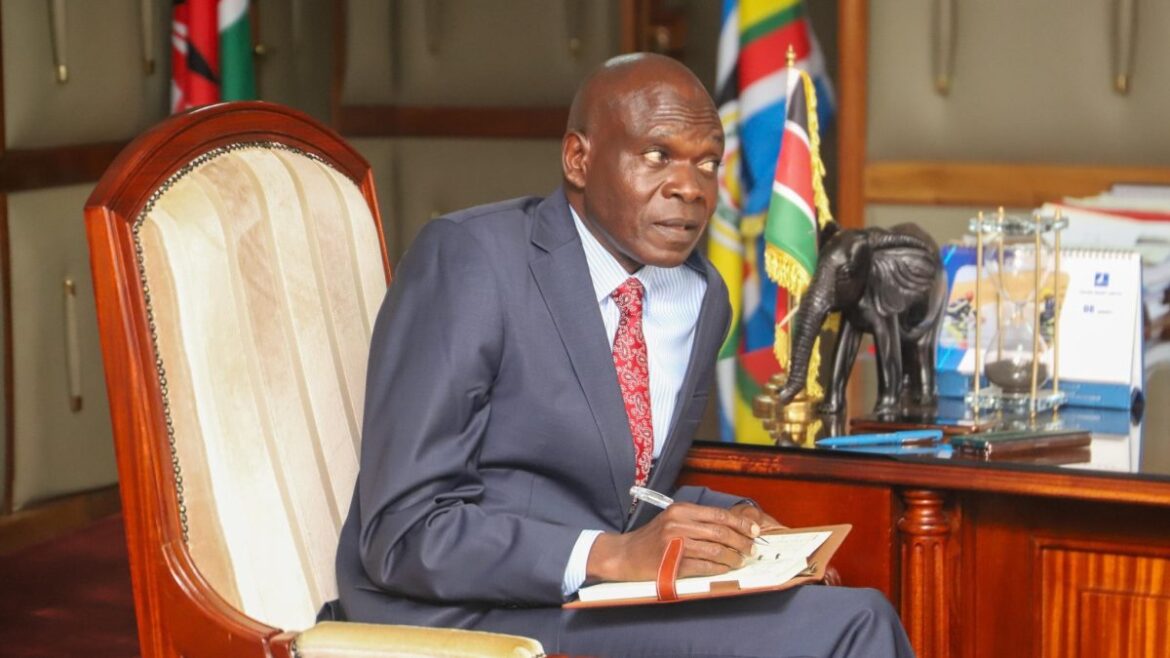
Mandera county speaker Omar Mahamed Maalim alias Saala , has been endorsed by the Egal Sharmake family to contest for the Mandera East constituency comes 2027.
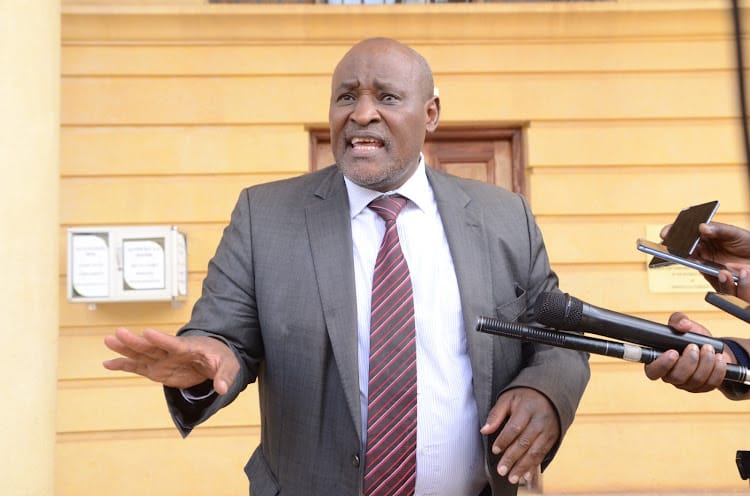
Speaking in Nairobi after a long consultations among the clan elders, family chair Musa Osman Yaro said that Maalim alias Saala is there prefered candidate for the Mandera East parliamentary seat having served it before and asked the community to support him fully.
”We as the leaders from the Egal family have anonymously endorsed Mr Omar as our next member of parliament come 2027,his track record is very clear having served in various positions including as the speaker” Said Musa
Musa who is also a director of the Kenya bureau of statistics (KBS) called on the community to support president William Ruto re-election come 2027 , saying that the president has done commendable job so far.
”I want also to take this opportunity and state categorical that as a community we have endorsed and support president William Ruto second term,his interest in the community is so big that we can’t neglect”Said Musa.
On his part,Omar a seasoned politician expressed confidence that he will win the next election having served one the same position before.
”I want to thank everyone including our elders for ensuring that we have had a peaceful process,in 2027 I want to promise you that we will win with a landslide”Said Saala
While emphasising on the unity of purpose, Sheikh Ali Nur who spoke on behalf of the elders urging the community to fully rally behind Mr Omar who is currently serving as the Mandera county assembly speaker.
”Yes as elders we call upon all members of the Egal family Sharmake to support this candidate,he is best among the best,he has previously served us,and he still serving us as the deputy Mandera county,let us ensure that he is back in parliament come 2027.
In 2013 to 2017 Mr Omar alias Saala severed as the first deputy governor for Mandera before he was elected sa the member of parliament for Mandera East constituency.
Omar is currently serving as the speaker of county assembly Mandera county.
Other leaders present was Abdikheir Aden Hussein,Mandera county director who called upon the clan to remain United ahead of the 2027 general election.
Court News
Chandaria family loses Sh. 2.5B to Shivali investments and other Companies Associated to Mr. Rajendra Sanghani.
In a landmark judgment, the shareholders and directors of Guardian Bank, namely the Chandaria family, have lost a long-standing legal dispute to Shivali Investments limited and associated parties owned by Mr. Rajendra (Raju) Sanghani.
The court has awarded a settlement of KSh 2.5 billion in favor of Shivali Holdings and others, bringing to conclusion a protracted case that has spanned several years. This ruling marks a significant development in the long-drawn legal battle and reinforces the rights of the claimants under the law.
The legal conflict originated from a 1999 agreement for the sale of 200,000 shares in Guilders International Bank Limited. The sellers were Shivali Investments Limited and other Companies.
The buyers were a group comprising Guardian Bank Limited and several individuals and companies known as the “obligors,” including Amit Chandaria, Hetul Chandaria, Bhavnish Chandaria, Nisha Dinesh Chandaria, Mahesh Maganlal Chandaria, and their firms Conifers Trading Limited, Chandaria Holdings Limited, Dima Limited, Goldera Limited, and Kevis Investments Limited.
Court of Appeal Partially Overturns High Court Ruling in Guilders Bank Share Dispute
In a significant ruling, the Court of Appeal in Nairobi has partially allowed an appeal in a long-running commercial dispute over the sale of shares in Guilders International Bank Limited, modifying a High Court judgment that had awarded sellers Kshs. 196 million with interest.
The case pitted Guardian Bank Limited and several individuals and companies linked to the Chandaria family against Shivali Investments Limited and three other investment firms. The appellate court found that while the sellers were entitled to the purchase price, the buyers were not liable for interest as previously ordered, and one appellant bank was exempt from direct payment obligations.
The dispute originated from a 1999 agreement where the respondents sold 200,000 shares in Guilders International Bank to the appellants for Kshs. 196 million. A Memorandum of Understanding (MoU) dated 13th October 1999 was initially drafted, labeled “subject to contract,” followed by a formal Sale Agreement on 30th December 1999.
The sellers alleged that the purchasers breached the contract by failing to pay the consideration, render accounts, or release securities, while the purchasers counterclaimed that the sellers misrepresented the bank’s loan portfolio value, leading to substantial losses.
The Court of Appeal re-evaluated the evidence and addressed several key issues. Firstly, it determined that the MoU was not a binding contract because it was explicitly “subject to contract,” meaning it was a preliminary document superseded by the subsequent Sale Agreement.
The court emphasized that the Sale Agreement contained an “entire agreement” clause, nullifying the MoU’s terms unless expressly incorporated, which they were not. This overturned the High Court’s finding that the MoU formed part of the final contract.
On the issue of whether the sellers’ claim was time-barred under the Limitation of Actions Act, the Court of Appeal upheld the High Court’s view that the suit, filed in 2005, was within the six-year limitation period. Amendments to the pleadings in 2017 did not introduce new claims but clarified existing ones, so the case was not time-barred.
Regarding the purchasers’ argument that unrecovered loans and undisclosed liabilities should reduce the purchase price, the appellate court found that the purchasers failed to prove they had exhausted all recovery avenues by the cut-off date of 31st December 2001.
Evidence showed that some loans were recovered after this date, and the purchasers did not formally notify the sellers of irrecoverable sums or undisclosed liabilities as required. However, the court acknowledged Kshs. 6,072,346 in undisclosed liabilities based on meeting minutes, which the sellers must bear.
The Court of Appeal also clarified liability for payment. It ruled that the 2nd to 9th appellants—individuals and companies referred to as “obligors” in the Sale Agreement—are jointly and severally liable to pay the Kshs. 196 million purchase price, but with interest at court rates from the suit’s filing date, not the 12% specified in the MoU.
The 1st appellant, Guardian Bank Limited, is not obligated to pay the consideration, as the contract placed this duty solely on the obligors. However, Guardian Bank must return securities provided by the sellers, except for four properties sold with the sellers’ consent.
Finally, the court dismissed the purchasers’ counterclaim for Kshs. 827 million, citing lack of evidence, and allocated costs, with Guardian Bank bearing one-quarter and the obligors three-quarters of the respondents’ costs. This judgment brings clarity to a complex commercial case, emphasizing the importance of adhering to contractual terms and timelines in business transactions.
Two Plead Not Guilty to Charges of Failing to Produce milk Import Documents, Released on Bail
Two Plead Not Guilty to Charges of Failing to Produce Import Documents, Released on Bail
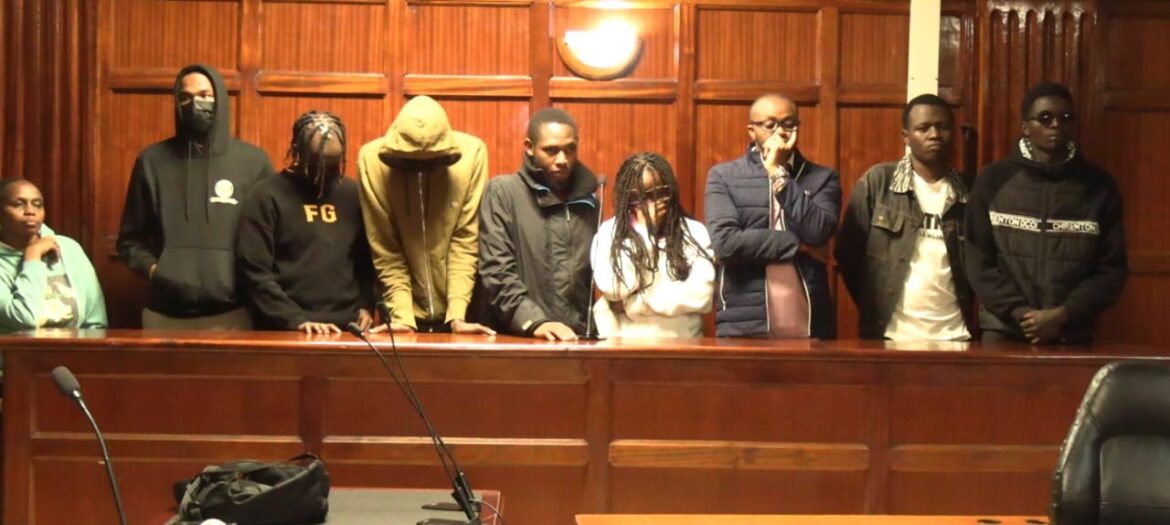
A Nairobi court has released two businesspeople on bail after they separately pleaded not guilty to charges of failing to produce legal documentation for imported goods.
Mohammed Abdullahi and Zamzam Ahmed faced the court on Thursday following their arrests for allegedly operating without the required order letters for imported products at their respective premises in the Eastleigh area.
Mohammed Abdullahi, represented by his lawyer Mr. Swaka, was accused of refusing to produce the documents on October 1, 2025, while selling milk products at BRT Com Wholesalers along Eastleigh Road.
In his defense, his lawyer informed the court that Abdullahi was a small-scale businessperson who had been cooperative with investigators. The lawyer pleaded for leniency and requested a cash bail of five thousand shillings.
The prosecution team, however, opposed the simple terms and requested the court to attach additional conditions to the bail. After hearing from both sides, the presiding magistrate ruled that Abdullahi be released on a cash bail of ten thousand shillings with one surety.
The court further issued an order for the defense to be supplied with all relevant legal documents, including copies of statements from witnesses. The case against Mohammed Abdullahi is scheduled for mention on October 16, 2025.
In a parallel case, Zamzam Ahmed was charged with a similar offense of failing to provide order letters for imported goods to an investigating officer. The charge stemmed from activities at Hafla Wholesalers and Salama Wholesalers, also located on Eastleigh Road within the Starehe Sub-County, on the first of this month.
The prosecution stated that Ahmed was selling dairy products and refused to present the necessary documentation for goods ordered from abroad.
Zamzam Ahmed also entered a plea of not guilty before the court. She was subsequently released by the magistrate on a cash bail of ten thousand shillings. Her case has been scheduled for a hearing at Court 6 on the sixteenth of this month.
Munja Group, HOP Flag Off First-Ever 1,600km EV Road Trip from Nairobi to Addis Ababa
The dream of a cleaner, greener Africa is set to take center stage this Sunday as Munja Group, in partnership with House of Procurement (HOP), flags off a historic 1,600-kilometre electric vehicle (EV) road trip from Nairobi to Addis Ababa.
Dubbed “Road to Addis,” the six-day journey is being billed as Africa’s first cross-border EV convoy and a landmark demonstration of what sustainable transport corridors could look like in the future.
The initiative is a consortium event led by Munja Group and supported by the Kenya Power and Lighting Company, the Ministry of Roads and Transport (Kenya), the Ministry of Transport and Logistics (Ethiopia), the Cars Society of Africa, and Eazy Power PLC.
In a statement, Munja described the road trip as a bold step toward redefining mobility and sustainability in Africa. The company emphasized that it is positioning itself not just as a vehicle supplier, but as a holistic solutions provider—offering EV leasing alongside solar-powered charging hubs and infrastructure in line with the United Nations Sustainable Development Goals (SDGs).
“It’s a bold statement that Africa is ready to embrace sustainable mobility. Our vision is to inspire Africans to believe that clean, connected, and sustainable transport isn’t just possible—it’s already here,” Munja Group said.
The convoy of branded EVs will set off from Nairobi on October 5 in a colorful public send-off before weaving through towns and communities across Kenya and Ethiopia. Along the route, temporary charging stations will be set up to showcase the practicality of integrated EV solutions.
Through community engagements, driver testimonials, and thought-leadership interviews, the consortium aims to highlight how EV adoption can be made accessible through Munja’s leasing model, while also exploring carbon credit generation as a financial tool to scale sustainability.
The journey will culminate in Addis Ababa on October 10, just ahead of the Africa E-Mobility Week (October 14–16), hosted by the UN Economic Commission for Africa (UNECA) and the UN Environment Programme (UNEP).
Kenya Power Managing Director and CEO, Dr. Eng. Joseph Siror, reaffirmed the company’s commitment to powering Kenya’s transition to clean and efficient transport.
“Kenya Power stands ready to support this transition by working with government, investors, and the public to position Kenya as a continental leader in e-mobility,” Siror said.
“Today, Kenya has more than 6,400 electric vehicles on the road—a number that continues to rise as access expands. But for e-mobility to succeed, it must extend beyond national borders, and seamless cross-border movement is essential.”
He added that Kenya Power is proud to be part of the Road to Addis expedition, noting that the company is already powering charging infrastructure in Kenya and demonstrating that electric mobility is viable for both people and goods across East Africa.
The Road to Addis campaign is expected to spark conversations on the future of travel, trade, and cross-border connectivity, positioning Africa at the forefront of the global e-mobility revolution.
[08:35, 03/10/2025] Caro Kubwa:
A petitioner, represented by Lawyer Harrison Kinyanjui, has formally asked three High Court judges to recuse themselves from hearing his case, alleging bias and a breach of his constitutional right to a fair hearing.
The request was filed by Joseph Enock Aura in Constitutional Petition, a case that challenges the purported impeachment of Deputy President Rigathi Gachagua and the nomination of Prof. Abraham Kithure Kindiki as his replacement.
In a “Notice of Motion for the Plea of Recusal of the Bench” dated October 1, 2025, drawn by J. Harrison Kinyanjui & Co. Advocates, Aura seeks the immediate disqualification of Justices E. Ogola, A. Mrima, and Lady Justice Frida Mugambi from any further involvement in the proceedings.
The core of his application hinges on the court’s decision to handle his petition separately from other consolidated petitions that he says raise identical and substantially similar constitutional issues. Aura contends that by isolating his case, the court is acting in a discriminatory manner, violating his rights under Article 50(1) of the Constitution, which guarantees a fair hearing before an impartial tribunal.
He argues that this separation creates a “real apprehension” of bias and could lead to an “unhappy state of conflicting decisions” from parallel court proceedings. His supporting affidavit, prepared by his legal team led by Lawyer Harrison Kinyanjui, states that the average, informed person would conclude there is a “real possibility” the court is biased against him.
The petitioner anchors his motion on a letter from Chief Justice Martha Koome dated January 23, 2025. In the letter, the Chief Justice acknowledged Aura’s request for his petition to be heard by a five-judge bench alongside the related cases. She directed that any request to “expand the subsisting Bench or otherwise reconstitute altogether should be made before the trial court,” to allow all parties in the related cases a chance to be heard.
Aura, through Lawyer Harrison Kinyanjui, argues that the current bench is attempting to make a determination on the issue of an expanded bench without the participation of the other consolidated petitioners, which he sees as a direct contravention of the Chief Justice’s guidance and a denial of due process.
Furthermore, the application cites several binding legal precedents to bolster the argument for consolidation. It references the Supreme Court’s ruling in Omoke v Kenyatta & 83 others, which emphasised that courts must consider the cost, time, and judicial resources when deciding on consolidation.
The petitioner asserts that it is “imprudent” to use scarce judicial resources on separate hearings for the same core issues. Another Supreme Court case, Law Society of Kenya v Centre for Human Rights & Democracy & 12 Others, is cited, where the court held that consolidating cases with the same central issue serves the interests of justice by preventing undesirable delays and ensuring expeditious resolution.
Aura fears that if the current bench continues to hear his petition in isolation, he will be strategically sidelined and potentially locked out by the technical doctrine of res judicata, which prevents the same matter from being litigated twice once a judgment has been delivered in the consolidated cases.
He maintains that his application for recusal is made in good faith to ensure transparency, fairness, and the rule of law are not compromised. If the recusal is granted, Aura, through his counsel Harrison Kinyanjui, has asked that the matter be mentioned before the Chief Justice for further directions.
The motion, filed by J. Harrison Kinyanjui & Co. Advocates, is yet to be heard, and its outcome will determine the future course of this high-stakes constitutional dispute.
Court Rejects Bid to Seize Mike Sonko’s Millions, Blasts Agency for “Cherry-Picking” Evidence
In a significant legal ruling on October 1, 2025, the High Court in Nairobi dismissed a bid by the government’s Assets Recovery Agency (ARA) to forfeit millions of shillings belonging to former Nairobi Governor Mike Sonko Mbuvi Gidion Kioko. The court found the evidence presented by the agency to be insufficient to prove that the funds in his ten bank accounts were the proceeds of crime.
The civil case sought the permanent forfeiture of over Ksh 18.5 million and approximately USD 67,906 found in various accounts at Equity Bank, Diamond Trust Bank, and Co-operative Bank. The ARA had argued there were reasonable grounds to believe the money was illicit, alleging it was derived from money laundering activities involving public funds from the Nairobi City County Government.
The agency’s investigator, Corporal Sautet Jeremiah, stated in an affidavit that between August 2017 and December 2019, the accounts received huge, suspicious cash deposits. He described this as a clear case of “splitting, smurfing and placement of funds” designed to conceal their origin. The ARA also noted that Mr. Sonko faced related criminal charges, including money laundering and conflict of interest, filed in late 2019 and early 2020.
Through his lawyer, Harrison Kinyanjui, the former governor mounted a robust defence, denying all allegations of money laundering. “It is one thing to have suspicion about someone money laundering and the theft of county government funds and it’s another thing to prove that indeed the suspicions are based on actual facts.”
Kinyanjui successfully argued that the funds were legitimate, originating from Sonko’s established business enterprises and, crucially, from the sale of several properties totaling over Ksh 572 million.
“Hon. Sonko’s lead evidence, which the court has analysed, shows that even before he became the Nairobi city governor he was engaged in businesses, he was engaged in the sale of real estate assets which brought him cash on a regular basis to his account.” said Lawyer Kinyajui.
The defence provided substantial documentary evidence, including sale agreements, to support this claim, explaining that deposits into bank safe lockers were a legitimate method of securing wealth from these transactions.
In his judgment, Justice Prof. (Dr.) Nixon Sifuna delivered a stinging critique of the ARA’s investigation. He found that the agency had failed to meet its legal burden of proving on a balance of probabilities that the funds were proceeds of crime.
The judge highlighted that the investigator did not provide bank statements from the period before Mr. Sonko became governor, which would have been essential for a fair comparison of his financial activity. He described this selective use of data as “either dishonest or rash,” and a form of “cherry-picking” that undermined the agency’s case.
The judge further faulted the investigator for not verifying the property sales presented by Lawyer Kinyanjui, noting that no attempts were made to interview the named buyers or confirm the transactions.
No witness statements were annexed to the ARA’s affidavit, relying solely on the investigator’s assertions. The judge emphasized that suspicion must be reasonable and founded on concrete evidence, stating that an agency cannot “wake up one day and start investigating someone,” and that investigations must be “thorough, air-tight and water-tight.”
Consequently, the court dismissed the ARA’s suit with costs and ordered that the preservation orders placed on the funds since February 2020 be immediately discharged. The ruling mandates that all funds be released forthwith to Mr. Sonko.
A Nairobi law firm has issued a sternly worded legal threat on behalf of Kenya’s former Deputy President, Rigathi Gachagua, concerning allegations that he illegally acquired an apartment. The law firm, Mabeya & Company Advocates, has given the accusing company, Royal Importers & Exporters Limited, twenty-four hours to admit liability and issue a public apology or face a defamation lawsuit. The demand is contained in a letter dated 2nd October 2025, written by Senior Partner Mabeya N. Moses, which has been seen by news outlets.
The dispute originates from a letter allegedly sent by Royal Importers & Exporters to Gachagua on 30th September 2025. In that communication, the company purportedly claimed that the former Deputy President had illegally taken possession of a specific apartment identified as Unit 02, 1st Floor Block D, on a property known as LR No. 330/317. The company further alleged that Gachagua had failed to pay the agreed purchase price of Kenya Shillings Twenty-Five Million.
In the robust response, lawyer Moses Mabeya flatly denies these claims on behalf of his client. The legal letter states that Gachagua is “a stranger to this kind of arrangement” and asserts that the former Deputy President has “at no time engaged with or transacted with your company.” It is further claimed that Gachagua has never even set foot in the apartment in question and was unaware of the Royal Importers & Exporters company before these allegations surfaced.
The core of the legal threat hinges on the accusation that the company’s statements were knowingly false and malicious. Mabeya’s letter argues that the allegations were crafted with the intent to “taint and tarnish our client’s reputation.”
It condemns the statements as “reckless with total disregard for the truth” and “factually wrong and unsubstantiated.” The letter highlights that the claims have been widely disseminated across both social and mainstream media, leading to what it describes as “widespread condemnation” and public outrage.
The legal document details the perceived damage, stating that the allegations have severely injured Gachagua’s reputation in his “personal, social, family, political capacity as well as in his societal standing.”
Lawyer Mabeya N. Moses accuses Royal Importers & Exporters of actively sensationalizing the issue by using “bloggers and other busy bodies” to publicize the defamatory statements. The firm contends that this conduct constitutes defamation under Kenyan law, specifically citing the Defamation Act and Article 33(3) of the Constitution of Kenya.
On the instructions of his client, Mabeya N. Moses has made three key demands. The first is an “immediate admission of liability” to begin negotiations on the amount of damages to be paid. The second demand is for the company to issue an immediate and unconditional written retraction of the allegations and to publish this retraction in two newspapers with nationwide circulation in Kenya. The third demand is similarly for an “appropriate apology” to be issued to Gachagua and published in two nationwide newspapers.
The letter concludes with a strict 24-hour ultimatum for compliance. Failure to provide evidence of meeting these demands within this timeframe, the lawyer warns, will result in the immediate filing of a defamation lawsuit. The firm states it has “peremptory instruction” to seek general, aggravated, and exemplary damages, along with the full cost of the legal suit. As of now, there has been no public response from Royal Importers & Exporters Limited regarding these demands.
Court Orders KCAA to Reinstate,Compensate Employee in Unfair Contract Case
In a significant ruling that underscores the obligations of public employers in Kenya, the Employment and Labour Relations Court in Nairobi has found the Kenya Civil Aviation Authority (KCAA) liable for unfairly failing to renew the contract of one of its inspectors. Justice Mathews Nduma, in a judgment delivered on 25th September 2025, held that the state corporation acted unreasonably, maliciously, and in violation of the constitutional rights of its employee, Vivian Nyakerario Ongwae.
The dispute centred on the non-renewal of Ms. Ongwae’s fixed-term contract as a Flight Operations Inspector, which expired on 31st December 2023. The court heard that the petitioner had diligently served the KCAA under three successive contracts since 2016. In September 2023, well within the stipulated timeframe, she formally applied for a renewal of her employment. However, the KCAA’s Director General, Mr. Emile Arao, only communicated the decision not to renew her contract via a letter dated 12th January 2024—twelve days after the contract had already lapsed.
Justice Nduma heavily criticised this delay, stating that while the employment contract gave the Director General sole discretion on renewal, it implicitly required him to communicate his decision within a reasonable time. The judge found that the authority’s failure to do so was a breach of the contract’s terms and an unfair labour practice. The court emphasized that the purpose of such notice clauses is to allow an employee, particularly one with significant financial commitments like a mortgage, adequate time to prepare for the end of their employment and seek alternative income.
Furthermore, the judgment highlighted that the KCAA’s own Human Capital Advisory Committee had recommended the renewal of Ms. Ongwae’s contract, a fact the respondent did not dispute. The court ruled that by overriding this positive recommendation without providing any reasons, the Director General violated Ms. Ongwae’s right to legitimate expectation and her right to fair administrative action as guaranteed under Articles 41 and 47 of the Constitution.
Consequently, the court issued several orders in favour of the petitioner. It quashed the KCAA’s decision contained in the January 2024 letter. It also issued a mandatory injunction compelling the authority to renew Ms. Ongwae’s contract for a term of three years, effective from the date of the judgment, on terms consistent with her previous engagements. Additionally, the KCAA was ordered to pay general damages equivalent to six months of her salary, which amounted to Kshs. 2,221,104, for the violation of her constitutional and contractual rights. This sum will attract interest until fully paid, and the KCAA must also bear the costs of the legal petition.
This ruling serves as a potent reminder to all public bodies that their administrative powers, even in contractual matters, must be exercised reasonably, procedurally fairly, and in a manner that respects the legitimate expectations of employees. The court affirmed that the constitutional principles governing public service are not merely decorative but impose substantive duties on decision-makers.
A former chief executive of MUA Insurance (Kenya) Limited, Lydia W.W. Kibaara, has threatened to sue the Mauritian-owned group for breach of contract and defamation. The dispute follows a newspaper report that her lawyers state falsely linked her to fraud and alleged she was dismissed from her role.
The conflict is detailed in a legal demand letter sent by the Nairobi law firm Danstan Omari & Associates to the Chairman of the MUA Group Board in Mauritius and the Group Chief Executive Officer of its Kenyan subsidiary. The letter demands corrective action within seven days to avoid a lawsuit.
According to the document, Ms. Kibaara is a professional with 27 years of experience in the insurance industry. She held senior positions at Britam and Jubilee Insurance Limited before becoming the CEO of Saham Assurance Kenya Limited.
After the MUA Group acquired Saham, she was appointed Chief Executive Officer of MUA Kenya and was nominated to the Group Board. The letter describes her career as unblemished, with no record of disciplinary, criminal, or regulatory issues.
Her departure from MUA in 2024 was governed by a Mutual Termination and Separation Agreement. The letter states this agreement was mutually and voluntarily negotiated, resulting in an orderly and amicable separation.
A key component of this agreement was Clause 10, a mutual non-disparagement clause, which bound both parties from making statements that would bring the other into disrepute.
The legal action stems from an article published in the Business Daily on September 23, 2025, titled “Mauritian firm MUA takes Shs. 1.6bn hit in Kenya fraud.” The article, attributed to investor briefings by MUA, claimed that Ms. Kibaara’s tenure was connected to “fraud” and “hidden liabilities” and stated that she was “dismissed” as CEO.
Her legal team refutes these claims forcefully. “These allegations are manifestly false,” the letter states, clarifying that “our client was never dismissed; she left under the negotiated mutual separation agreement.” They further reveal that a PwC forensic audit commissioned by MUA itself exonerated her, concluding: “We did not identify sufficient evidence for us to conclude that there has been intentional concealment or dishonesty by any party.”
The document states that when Ms. Kibaara contacted MUA about the article, the company acknowledged that the statements came from their briefings but claimed the newspaper had “misquoted” or “misinterpreted” them. Her legal team asserts that this is no defence,”and that by failing to promptly correct the public record, MUA is in breach of their separation contract.
The law firm has issued a seven-day ultimatum for MUA to comply with four key demands. These include a formal admission of the breach, the publication of a prominent retraction and unconditional apology, an immediate cessation of all disparaging statements, and entering into good-faith negotiations to determine financial damages for the harm caused.
Failure to meet these demands will result in immediate legal proceedings. The law firm states it will file for breach of contract, seek injunctive relief, and claim aggravated and exemplary damages.